✅ Edibility Note
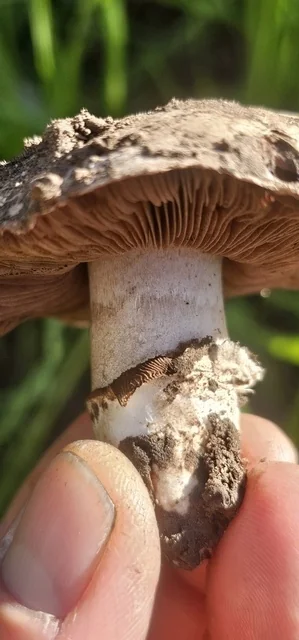
CHOICE EDIBLE: Excellent eating with firm dense texture that holds up well in cooking. Often more flavorful than store-bought button mushrooms. Cook thoroughly. Critical identification: verify very SHORT STOUT stem (distinctive feature), DOUBLE ring, FREE gills turning pink then chocolate brown, CHOCOLATE BROWN spore print, NO volva at base, urban/disturbed habitat. The stocky build and pavement habitat are distinctive. Wash well as specimens often grow in dirty urban environments. Highly resistant to bruising and insect damage.
Description
The Pavement Mushroom or Spring Agaricus is a stocky robust species with a cap 5-15 cm across, initially rounded becoming convex. The cap is white to cream, smooth or with slight cracking, often staining yellowish-brown with age or bruising. The gills are free, initially pale pink becoming chocolate brown. The stem is 3-8 cm tall, very short and stout (distinctive), white, with a double ring (often appearing as two separate rings, hence 'bitorquis'). The flesh is firm, white, with a mild pleasant odor. Notably tough and resilient compared to other Agaricus.
Habitat & Distribution
Habitat: Found in highly disturbed urban environments including sidewalk cracks, compacted soil along roads, parking lots, gravel paths, landscaped beds, and under asphalt. Remarkably tolerant of poor soil and human disturbance. Also in gardens and lawns with hard-packed soil. Fruits scattered to clustered, often pushing through hard surfaces.
Region: Europe (native), North America (widespread, all regions), California (very common), Urban areas worldwide, Temperate to subtropical climates, Cosmopolitan in cities
Seasonality
Spring through fall (April-November) with peak in late spring and early summer. Can fruit year-round in mild climates like California. More cold-tolerant than most Agaricus species, often appearing in cool weather when others are absent.
Typical months: Apr-Nov
Common Lookalikes
Always verify identification to avoid these similar species:
- Agaricus campestris (edible) - more delicate, taller stem, grassland habitat
- Agaricus bisporus (cultivated mushroom, edible) - similar but cultivated, less robust
- Young Amanita species (some deadly) - have a volva at base, gills don't turn pink-brown
- Agaricus bernardii (edible) - coastal species, briny habitat, similar appearance
Related Species
Browse all species in the Mushroom Database →
Track Your Pavement Mushroom Finds
Pin the patch before you leave it. Coordinates, photos, and field notes stay AES-encrypted on your device — and the offline lookalike guide travels with you into the deep woods.
Download Mushroom TrackerDisclaimer: This guide is for educational purposes only. Never consume a wild mushroom unless you are 100% certain of its identification.