✅ Edibility Note
EDIBLE: Considered edible with good flavor and texture when cooked thoroughly. Less commonly collected than A. augustus but similar quality. Critical identification: verify pleasant ALMOND-ANISE odor (not phenolic), distinctive crocodile-skin scale pattern on cap, FREE gills turning pink then chocolate brown, CHOCOLATE BROWN spore print, NO volva at base. Avoid specimens with intense yellow bruising or phenolic chemical odor. The distinctive scaly pattern is helpful for identification. Cook thoroughly before consuming.
Description
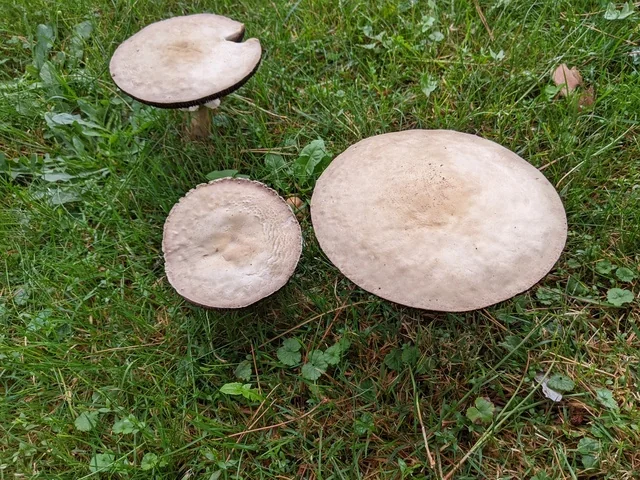
The Crocodile Agaricus is a distinctive species with a cap 8-18 cm across, initially rounded becoming broadly convex to flat. The cap is white with a striking pattern of dark brown to gray-brown recurved scales arranged in a crocodile-skin pattern (diagnostic feature), more concentrated toward the center. The gills are free, initially pale pink becoming chocolate brown. The stem is 6-12 cm tall, white, smooth or with fine scales, with a large pendant ring. The flesh is white, bruising slowly yellow to brown, with a pleasant almond-anise odor.
Habitat & Distribution
Habitat: Found in mixed coniferous and hardwood forests, woodland edges, parks with mature trees, and landscaped areas with wood chips. Grows terrestrially in humus-rich soil and woody debris. Fruits scattered to gregarious, often in small groups. Prefers areas with decomposing organic matter.
Region: California (common), Pacific Northwest (occasional), Southwestern United States, Mediterranean climates, Western North America (primarily), Warm temperate regions
Seasonality
Late summer through fall (August-November) in most regions. In California and mild climates, may fruit in winter (December-February). Peak fruiting occurs in fall after warm rains. More common in years with consistent moisture.
Typical months: Aug-Feb
Common Lookalikes
Always verify identification to avoid these similar species:
- Agaricus augustus (edible) - larger, more golden-brown scales, stronger anise odor
- Agaricus subrutilescens (edible) - similar appearance, wine-red staining on stem base
- Agaricus moelleri (toxic) - yellows intensely, phenolic odor instead of anise
- Large Amanita species (some deadly) - have volva at base which Agaricus lacks
Related Species
Browse all species in the Mushroom Database →
Track Your Macro Mushroom Finds
Pin the patch before you leave it. Coordinates, photos, and field notes stay AES-encrypted on your device — and the offline lookalike guide travels with you into the deep woods.
Download Mushroom TrackerDisclaimer: This guide is for educational purposes only. Never consume a wild mushroom unless you are 100% certain of its identification.