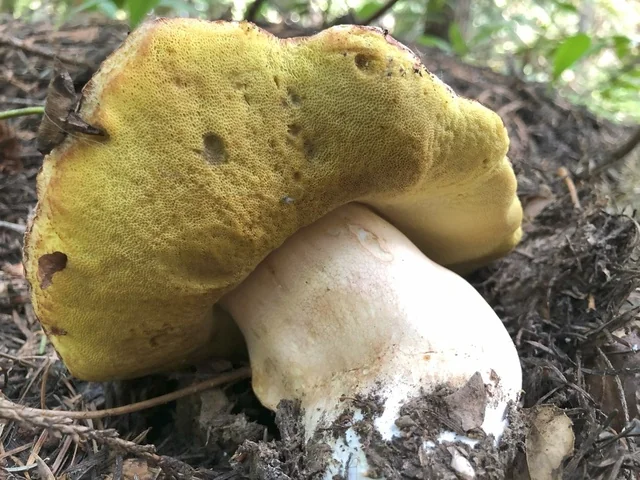
✅ Edibility Note
CHOICE EDIBLE: Spring King is highly prized for its early appearance and excellent flavor. Firm texture and rich taste make it a favorite among foragers. The spring fruiting period and pinkish-toned cap help distinguish it from other species. Always cook thoroughly before eating.
Description
The Spring King Bolete displays a pinkish-brown to reddish-brown cap (5-25 cm) with smooth, often wrinkled surface when mature. Pores are white when young, becoming yellowish with age, showing no bruising reaction. The thick, white stem has white reticulation and often shows pinkish-red tones at the base. White flesh is firm and does not stain when cut. Spore print is olive-brown.
Habitat & Distribution
Habitat: Mycorrhizal with pine, Douglas fir, and other conifers in low to mid-elevation forests. Associated with snowmelt and spring moisture. Prefers sandy or gravelly soils under mature conifers.
Region: Western United States, Pacific Northwest, California mountains, Rocky Mountains, Oregon, Washington, British Columbia
Seasonality
Spring through early summer (April-July), with peak fruiting in May-June. Known as 'Spring King' for early seasonal appearance, often fruiting when snow is still present at higher elevations.
Typical months: Apr-Jul
Common Lookalikes
Always verify identification to avoid these similar species:
- Boletus edulis - later season, different cap color
- Boletus pinophilus - darker reddish-brown cap
- Tylopilus felleus - pink pores, bitter taste
- Other spring Boletus species - all edible
Related Species
Browse all species in the Mushroom Database →
Track Your Spring King Bolete Finds
Pin the patch before you leave it. Coordinates, photos, and field notes stay AES-encrypted on your device — and the offline lookalike guide travels with you into the deep woods.
Download Mushroom TrackerDisclaimer: This guide is for educational purposes only. Never consume a wild mushroom unless you are 100% certain of its identification.