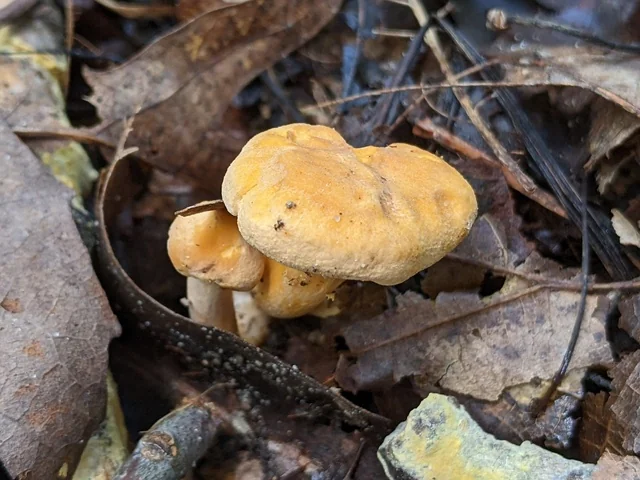
✅ Edibility Note
EDIBLE: The Peach Chanterelle is a good edible mushroom with mild flavor, notable for its delicate peach coloration. Like all chanterelles, the key identification feature is the blunt, forked ridges on the underside that feel waxy and are fused to the cap, rather than true gills. The pale peach color and southeastern distribution help distinguish it from other species. Always verify it grows from soil in association with trees, never on wood. Flavor is mild and pleasant; best sautéed or used in combination with other mushrooms.
Description
The Peach Chanterelle has a distinctive peach to pale pinkish-orange or salmon-colored cap 2-8 cm wide with a smooth, slightly velvety surface. The cap becomes shallowly funnel-shaped with age and has wavy, irregular margins. The underside features blunt, shallow, forked ridges (NOT true gills) that are pale peach to pinkish-cream, widely spaced, and run down the stem. The ridges are less pronounced than many chanterelles. The stem is solid, 2-6 cm tall, smooth, white to pale peach. Flesh is white to pale cream, firm, with a mild odor. Spore print is white to pale cream.
Habitat & Distribution
Habitat: Mycorrhizal with southeastern hardwoods, particularly oak species (especially water oak, willow oak), sweetgum, and hickory. Found in bottomland hardwood forests, mixed pine-hardwood forests, and riparian areas throughout the southeastern coastal plain. Prefers moist, sandy soils and areas near streams.
Region: Southeastern United States, Georgia and Florida, Carolinas, Gulf Coast states (Alabama, Mississippi, Louisiana), Eastern Texas
Seasonality
Summer (June-September), fruiting during warm, humid periods after heavy summer rains. Peak season is typically July-August in most of its range. More tolerant of heat and humidity than northern chanterelle species.
Typical months: Jun-Sep
Common Lookalikes
Always verify identification to avoid these similar species:
- Cantharellus lateritius - Edible, more orange-pink, larger, more pronounced ridges, overlapping range
- Cantharellus cinnabarinus - Edible, brighter red-pink color, smaller, otherwise similar
- False Chanterelle (Hygrophoropsis aurantiaca) - Not toxic but poor quality, has true thin gills, more orange
Related Species
Browse all species in the Mushroom Database →
Track Your Peach Chanterelle Finds
Pin the patch before you leave it. Coordinates, photos, and field notes stay AES-encrypted on your device — and the offline lookalike guide travels with you into the deep woods.
Download Mushroom TrackerDisclaimer: This guide is for educational purposes only. Never consume a wild mushroom unless you are 100% certain of its identification.