✅ Edibility Note
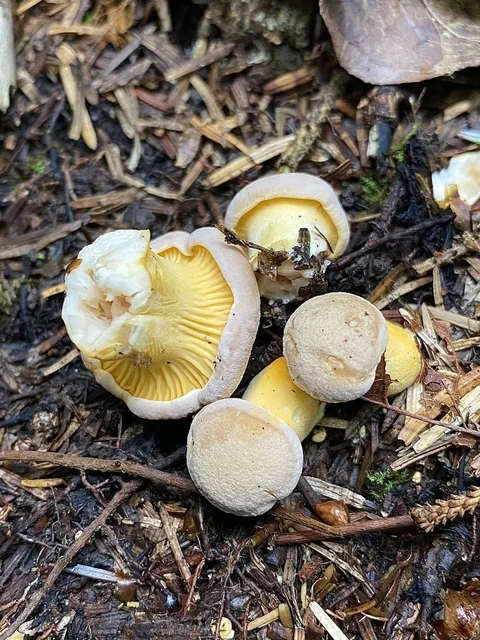
EDIBLE: The Rainbow Chanterelle is an excellent edible mushroom notable for its distinctive pinkish coloration. Like all chanterelles, the key identification feature is the thick, blunt, forked ridges on the underside that feel waxy and are fused to the cap flesh, rather than true gills. The unique rose-pink color makes it relatively easy to distinguish from other chanterelles and from toxic lookalikes. Always verify it grows from soil near trees. Has a mild, pleasant flavor similar to other chanterelles; excellent sautéed or in cream-based dishes.
Description
The Rainbow Chanterelle (also called Rosy Chanterelle) has a distinctive pinkish to salmon-orange or rose-colored cap 3-12 cm wide, often with purple-pink tones that give it its common name. The cap surface is smooth to slightly wrinkled, becoming funnel-shaped with age, with wavy, irregular margins. The underside features thick, blunt, forked ridges (NOT true gills) that are pinkish-orange to salmon-pink, widely spaced, and run down the stem. The stem is solid, 3-9 cm tall, pinkish to white, often with purple-pink tones at the base. Flesh is white to pale pink, firm, with a mild fruity odor. Spore print is white to pale cream.
Habitat & Distribution
Habitat: Mycorrhizal with Pacific Northwest conifers including Douglas fir, western hemlock, and Sitka spruce in coastal forests. Also found with tanoak and madrone in mixed forests. Prefers well-drained slopes with thick moss and duff layers in coastal and montane coniferous forests.
Region: Pacific Northwest (British Columbia to Northern California), Coastal Oregon and Washington, Vancouver Island, Northern California coastal mountains, Olympic Peninsula
Seasonality
Fall through early winter (September-December), fruiting with the onset of fall rains. Peak season is typically October-November in the Pacific Northwest. Often fruits alongside C. formosus but tends to appear slightly later in the season.
Typical months: Sep-Dec
Common Lookalikes
Always verify identification to avoid these similar species:
- Cantharellus formosus - Edible, more golden-orange without pinkish tones, otherwise very similar
- Cantharellus cascadensis - Edible, paler yellow-cream, lacks pink tones, higher elevation
- False Chanterelle (Hygrophoropsis aurantiaca) - Not toxic but poor quality, has true thin gills, more orange
Related Species
Browse all species in the Mushroom Database →
Track Your Rainbow Chanterelle Finds
Pin the patch before you leave it. Coordinates, photos, and field notes stay AES-encrypted on your device — and the offline lookalike guide travels with you into the deep woods.
Download Mushroom TrackerDisclaimer: This guide is for educational purposes only. Never consume a wild mushroom unless you are 100% certain of its identification.