✅ Edibility Note
CHOICE EDIBLE: Excellent mild, sweet flavor similar to other Hericium species. The distinctive white coral-like branching with spines all around branches makes misidentification unlikely. No toxic lookalikes exist. Best when fresh and pure white - yellowing indicates age but is still edible. Clean gently to remove debris from intricate branches and spines.
Description
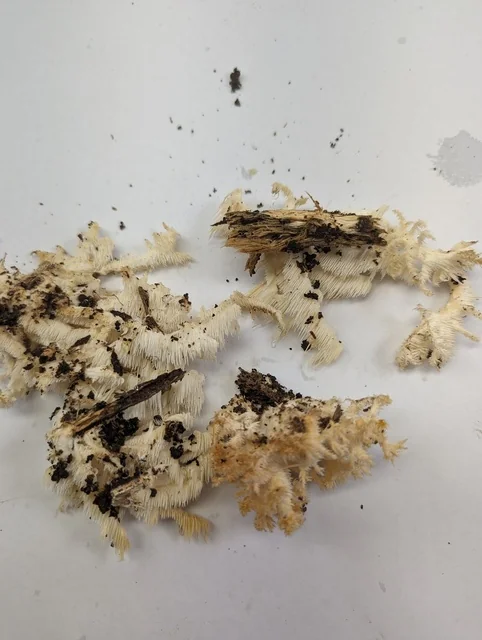
Coral Tooth has a white, extensively BRANCHED coral-like structure (10-30 cm wide) with numerous thin, delicate branches that repeatedly subdivide. The spines (0.5-1.5 cm long) grow ALL AROUND the branches in tufts or clusters, not just on undersides - creating a fuzzy, bristly appearance on all branch surfaces. Branches are slender, round in cross-section, intricately divided. The entire structure is white when fresh, yellowing with age. Flesh is white, tender, with mild taste. Distinguished by its highly branched coral-like form with spines completely encircling branches.
Habitat & Distribution
Habitat: Saprobic on hardwood trees, especially oak, beech, maple, and birch. Grows on dead logs, standing dead trees, and stumps. Typically fruits from well-decayed wood. Not mycorrhizal. Usually appears singly on a log or tree.
Region: Eastern United States, Midwest, Pacific Northwest, Rocky Mountains, Canada, Europe
Seasonality
Late summer through fall (August-October), occasionally into early winter in mild climates.
Typical months: Aug-Oct
Common Lookalikes
Always verify identification to avoid these similar species:
- Hericium americanum (Bear's Head) - spines only on branch undersides, thicker branches
- Hericium erinaceus (Lion's Mane) - unbranched globular mass
- Hericium abietis - grows on conifers, less extensively branched
Related Species
Browse all species in the Mushroom Database →
Track Your Coral Tooth Finds
Pin the patch before you leave it. Coordinates, photos, and field notes stay AES-encrypted on your device — and the offline lookalike guide travels with you into the deep woods.
Download Mushroom TrackerDisclaimer: This guide is for educational purposes only. Never consume a wild mushroom unless you are 100% certain of its identification.