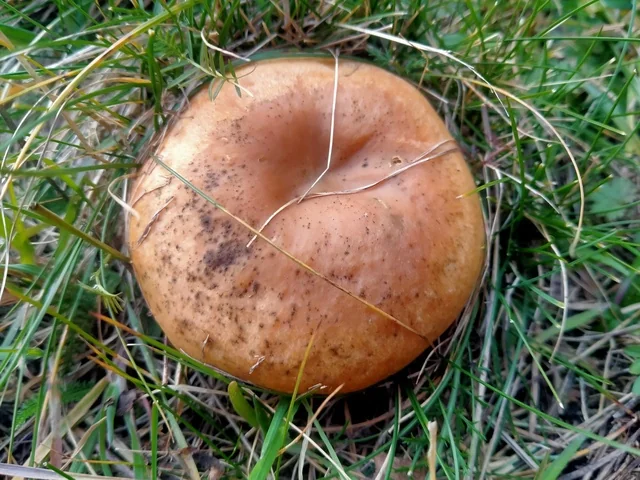
✅ Edibility Note
CHOICE EDIBLE: Highly prized in Europe, one of the best Lactarius species. The ORANGE LATEX that stains green is diagnostic. Mild, pleasant flavor. Best when young and firm. The mushroom itself may stain green when cooked or preserved - this is normal and safe. Some individuals may experience mild digestive upset. Cook thoroughly.
Description
Saffron Milk Cap has an orange cap (4-14 cm) with concentric zones of darker orange, often with greenish stains when old or bruised. The cap is convex to funnel-shaped with an inrolled margin when young. Gills are orange, crowded, decurrent, staining green. The stem is orange with darker orange pits or scrobiculations. The KEY FEATURE is the ORANGE TO CARROT-ORANGE LATEX (milk) that exudes when cut - this latex slowly stains green. Flesh is white to pale orange. Spore print is pale cream. The bright orange milk is diagnostic.
Habitat & Distribution
Habitat: Mycorrhizal with PINE (Pinus species), especially exotic planted pines. Grows on the ground under pine trees in plantations, parks, and ornamental plantings. Often found under Mediterranean stone pines and other introduced pines. Prefers sandy soils.
Region: Introduced in North America, California, Pacific Northwest, Europe (native), Where pines are planted
Seasonality
Fall (September-December), fruiting after rains. In mild climates may fruit into winter.
Typical months: Sep-Dec
Common Lookalikes
Always verify identification to avoid these similar species:
- Lactarius rubrilacteus - orange but latex is red not carrot-orange
- Lactarius thyinos - similar, latex also orange but different tree host
- Lactarius sanguifluus - latex wine-red
- Russula species - NO LATEX, brittle flesh
Related Species
Browse all species in the Mushroom Database →
Track Your Saffron Milk Cap Finds
Pin the patch before you leave it. Coordinates, photos, and field notes stay AES-encrypted on your device — and the offline lookalike guide travels with you into the deep woods.
Download Mushroom TrackerDisclaimer: This guide is for educational purposes only. Never consume a wild mushroom unless you are 100% certain of its identification.