✅ Edibility Note
EDIBLE when young, but CAUTION: Like other conifer-dwelling Laetiporus, this species more commonly causes digestive upset than hardwood species. Hemlock specimens can cause stomach issues in sensitive individuals. Harvest only very young, tender specimens. Start with small amounts to test tolerance. Cook thoroughly. The hemlock host and northeastern range help identification. Some people tolerate it well, others experience problems.
Description
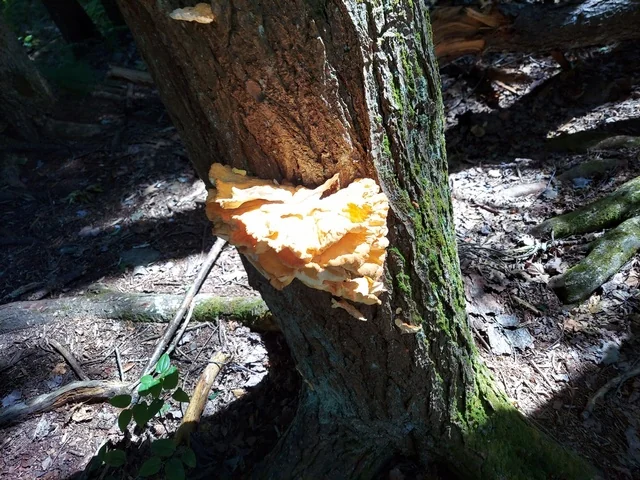
Bright orange to salmon bracket with sulfur-yellow to cream pore surface, forming large overlapping shelves 2-10 inches wide on hemlock. Often paler yellow pores than L. sulphureus. Soft and succulent when young. Distinguished by northeastern range and strict association with eastern hemlock. Forms rosettes on trunks and logs. Annual bracket.
Habitat & Distribution
Habitat: Parasitic and saprobic specifically on living and dead eastern hemlock (Tsuga canadensis). Strongly host-specific to hemlock in northeastern forests. Forms shelving brackets on trunks, stumps, and fallen logs. Causes brown cubical heart rot. Common where eastern hemlock occurs.
Region: Northeastern United States, Great Lakes region, Appalachian Mountains, Southeastern Canada, Eastern hemlock range, New England to Georgia
Seasonality
Summer through fall, typically July-October. Peak fruiting in August-September. Flushes after warm summer rains. Similar timing to other northern Laetiporus species.
Typical months: Jul-Oct
Common Lookalikes
Always verify identification to avoid these similar species:
- Laetiporus conifericola (western mountains, different conifers)
- Laetiporus sulphureus (on hardwoods, not conifers)
- Other Laetiporus species (different hosts/ranges)
- Jack-o'-lantern (Omphalotus) - toxic, has gills not pores
Related Species
Browse all species in the Mushroom Database →
Track Your Chicken of the Woods Finds
Pin the patch before you leave it. Coordinates, photos, and field notes stay AES-encrypted on your device — and the offline lookalike guide travels with you into the deep woods.
Download Mushroom TrackerDisclaimer: This guide is for educational purposes only. Never consume a wild mushroom unless you are 100% certain of its identification.