✅ Edibility Note
EDIBLE WHEN YOUNG but quality varies - young specimens are mild and edible, but older specimens develop BITTER TASTE that makes them inedible. Must collect very young, fresh specimens before bitterness develops. The large dark scales and spines/teeth on underside make identification straightforward. Some individuals find even young specimens slightly bitter. Not recommended for beginners due to variable quality.
Description
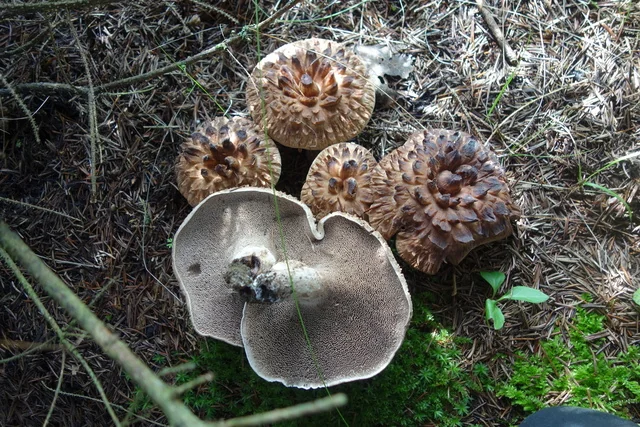
Scaly Hedgehog has a large brown cap (5-25 cm) covered with distinctive LARGE, UPTURNED SCALES that create a shaggy, imbricated (overlapping) pattern - scales are dark brown to blackish-brown, giving a shingled appearance. The underside is covered with brittle, downward-pointing SPINES or TEETH instead of gills or pores - these spines are grayish to brown. The stem is thick, short, grayish-brown, smooth or slightly scaly. The flesh is whitish to grayish, thick, firm, with a bitter taste in older specimens. Spore print is brown. Much larger and darker than Hydnum species.
Habitat & Distribution
Habitat: Mycorrhizal with conifers, especially pine, spruce, and fir. Found on the ground in coniferous and mixed mountain forests. Often grows scattered or in small groups. Prefers acidic soils in northern and montane forests.
Region: Pacific Northwest, Rocky Mountains, Northeast, Upper Midwest, Europe, Asia
Seasonality
Late summer through fall (August-October), earlier than many Hydnum species.
Typical months: Aug-Oct
Common Lookalikes
Always verify identification to avoid these similar species:
- Sarcodon scabrosus - similar but with different scale pattern
- Hydnum species - much smaller, paler, lack large dark scales
- Phaeolus schweinitzii (Dyer's Polypore) - grows on wood, has pores not spines
Related Species
Browse all species in the Mushroom Database →
Track Your Scaly Hedgehog Finds
Pin the patch before you leave it. Coordinates, photos, and field notes stay AES-encrypted on your device — and the offline lookalike guide travels with you into the deep woods.
Download Mushroom TrackerDisclaimer: This guide is for educational purposes only. Never consume a wild mushroom unless you are 100% certain of its identification.