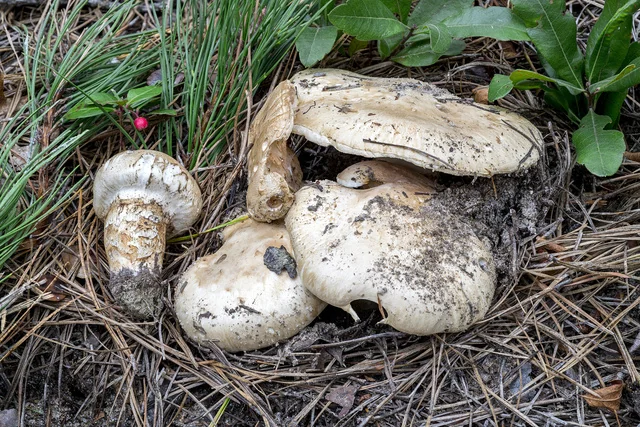
✅ Edibility Note
CHOICE EDIBLE: Highly prized and commercially harvested, selling for $20-100+ per pound. The strong CINNAMON/SPICY ODOR is the key identification feature - once smelled, never forgotten. Best when young and firm ('buttons' or half-emerged). Clean carefully to preserve delicate flavor. CRITICAL: Never confuse with toxic Amanita smithiana - check for absence of volva (cup at base) and verify cinnamon odor. The thick cottony ring and absence of volva distinguish it from deadly Amanitas.
Description
American Matsutake has a robust white to cream cap (7-20 cm) that develops brownish fibrillose patches or stains with age, especially at center. The cap is convex to flat, dry, smooth to fibrillose. Gills are white, attached, crowded, staining brown. The stem is thick, white, very firm and solid, with a DISTINCTIVE THICK PARTIAL VEIL that leaves a LARGE COTTONY RING on the upper stem. The diagnostic feature is the STRONG SPICY, CINNAMON, or RED HOT candy-like ODOR - unmistakable and powerful. Flesh is white, very dense and firm. Spore print is white. Often partially buried, creating soil mounds.
Habitat & Distribution
Habitat: Mycorrhizal with CONIFERS in western North America, especially pine, Douglas fir, hemlock, and true firs. Forms obligate mycorrhizal relationships. Grows on the ground, often deeply buried in duff, needle litter, or sandy soil. Found in mature conifer forests from sea level to high mountains. Prefers well-drained soils.
Region: Pacific Northwest, British Columbia, Northern California, Rocky Mountains, Alaska
Seasonality
Fall (September-November), fruiting in cool autumn weather after rains. Prime season October in Pacific Northwest.
Typical months: Sep-Nov
Common Lookalikes
Always verify identification to avoid these similar species:
- Tricholoma matsutake - Asian species, virtually identical
- Tricholoma murrillianum - southwestern species, similar
- Amanita smithiana - TOXIC - has volva at base, sickly sweet odor not cinnamon
- Catathelasma - similar but has double veil, different odor
Related Species
Browse all species in the Mushroom Database →
Track Your American Matsutake Finds
Pin the patch before you leave it. Coordinates, photos, and field notes stay AES-encrypted on your device — and the offline lookalike guide travels with you into the deep woods.
Download Mushroom TrackerDisclaimer: This guide is for educational purposes only. Never consume a wild mushroom unless you are 100% certain of its identification.