✅ Edibility Note
CHOICE EDIBLE: Highly prized in the Southwest, commercially harvested. The CINNAMON/SPICY ODOR is key for identification, though sometimes subtler than northern matsutake. Best when young and firm. CRITICAL: Always check for absence of volva (cup at base) to rule out toxic Amanita species. The ring and cinnamon odor are diagnostic. Some foragers consider it slightly less aromatic than T. magnivelare but still excellent.
Description
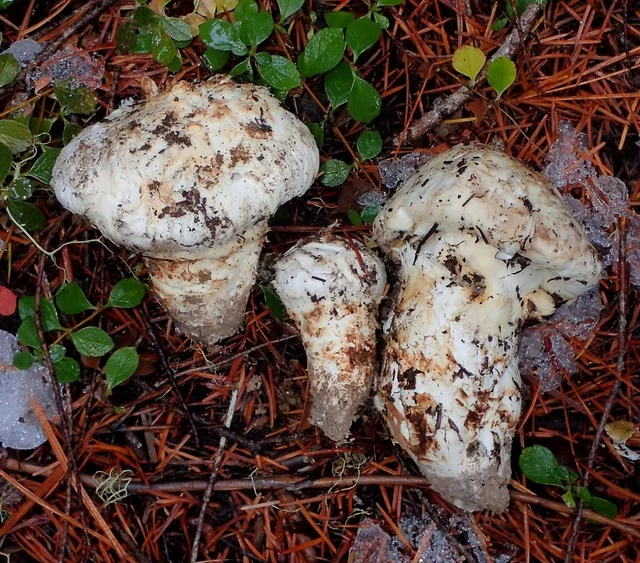
Southwestern Matsutake has a robust white to cream cap (6-15 cm) that develops brownish tones with age. The cap is convex to flat, dry, smooth to slightly fibrillose. Gills are white to cream, attached, crowded. The stem is thick, white, firm, with a PARTIAL VEIL that leaves a COTTONY RING or fibrillose zone on the upper stem - often less prominent than T. magnivelare. The diagnostic feature is the SPICY, CINNAMON-LIKE ODOR, though sometimes less intense than the Pacific Northwest matsutake. Flesh is white, firm, dense. Spore print is white. Adapted to southwestern high elevation forests.
Habitat & Distribution
Habitat: Mycorrhizal with CONIFERS in southwestern mountains, especially ponderosa pine, white fir, and Douglas fir. Forms obligate mycorrhizal relationships. Grows on the ground in duff or needle litter in high elevation conifer forests (typically 6,000-10,000 feet). Requires mature forests with specific mycorrhizal networks.
Region: New Mexico, Arizona, Southern Colorado, Southern Rocky Mountains, Southwestern high mountains
Seasonality
Late summer through fall (August-October) in southwestern mountains, fruiting after monsoon rains.
Typical months: Aug-Oct
Common Lookalikes
Always verify identification to avoid these similar species:
- Tricholoma magnivelare - Pacific Northwest species, very similar
- Tricholoma matsutake - Asian species
- Amanita smithiana - TOXIC - has volva at base
- Other white Tricholoma species - lack cinnamon odor
Related Species
Browse all species in the Mushroom Database →
Track Your Southwestern Matsutake Finds
Pin the patch before you leave it. Coordinates, photos, and field notes stay AES-encrypted on your device — and the offline lookalike guide travels with you into the deep woods.
Download Mushroom TrackerDisclaimer: This guide is for educational purposes only. Never consume a wild mushroom unless you are 100% certain of its identification.