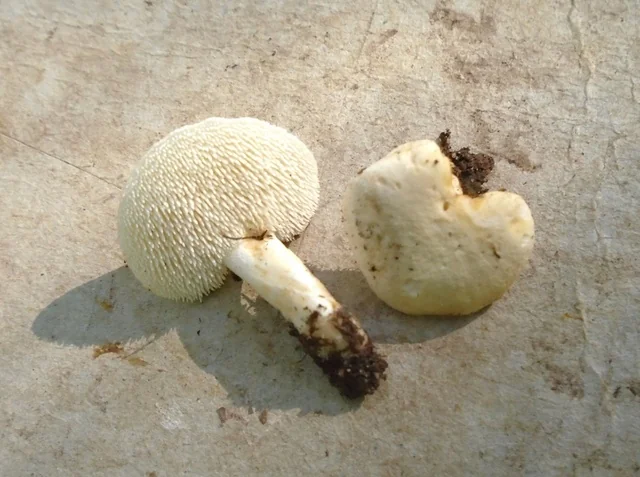
✅ Edibility Note
EDIBLE: Mild, pleasant flavor similar to H. repandum. The pure white color and distinctive spines/teeth make misidentification unlikely. Clean thoroughly as spines trap debris and pine needles. Collect young specimens for best texture - older specimens may develop slight bitterness.
Description
White Hedgehog has a pure white to cream-colored cap (3-10 cm) that may develop pale yellowish tones with age or bruising. The cap shape is convex to irregular with wavy margins. The underside is covered with brittle, downward-pointing SPINES or TEETH instead of gills or pores - these spines are white to cream, easily detached when rubbed. The stem is white, central to off-center, often curved, smooth, firm. The flesh is white, thick, brittle, with a mild taste and pleasant odor. Spore print is white. Distinguished by its consistently pale coloration.
Habitat & Distribution
Habitat: Mycorrhizal with conifers, especially pine and spruce. Found on the ground in coniferous and mixed forests. Often grows scattered or in small groups in needle duff or moss. Prefers well-drained acidic soils.
Region: Pacific Northwest, Rocky Mountains, Northeast, Europe
Seasonality
Late summer through fall (September-November), occasionally into early winter in mild climates.
Typical months: Sep-Nov
Common Lookalikes
Always verify identification to avoid these similar species:
- Hydnum repandum (Sweet Tooth) - usually has orange or peachy tones
- Hericium species - different growth form, longer cascading spines
- Climacodon septentrionale - grows on wood, larger teeth
Related Species
Browse all species in the Mushroom Database →
Track Your White Hedgehog Finds
Pin the patch before you leave it. Coordinates, photos, and field notes stay AES-encrypted on your device — and the offline lookalike guide travels with you into the deep woods.
Download Mushroom TrackerDisclaimer: This guide is for educational purposes only. Never consume a wild mushroom unless you are 100% certain of its identification.